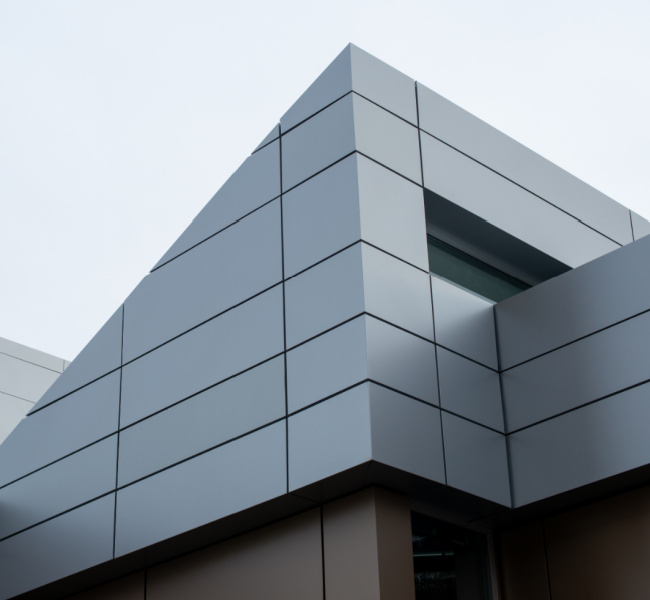
What ACM panels actually are, how they perform in Alberta weather, and what the post-Grenfell fire standards mean for new commercial builds and renovations.
Walk through Calgary’s downtown core or any of the city’s newer commercial districts and the buildings that stand out visually almost always share one feature: custom cladding. Aluminum composite material (ACM) panels, perforated metal facades, and specialty cladding systems have become the default for architects designing commercial buildings that want to read as contemporary, intentional, and premium. The market has matured rapidly — and so have the standards governing it.
This guide is written for Calgary commercial property owners, developers, and facility managers weighing custom cladding decisions. It covers what ACM is and isn’t, how the fire standards have changed since the Grenfell Tower disaster, the installation details that determine whether a custom cladding project succeeds, and the lead-time and sourcing considerations that make or break project timelines.
What ACM panels actually are
Aluminum composite material is a three-layer sandwich: two thin aluminum face sheets bonded to a core material. The core can be polyethylene (PE), fire-resistant mineral-filled (FR), or a hybrid. The composite is rigid enough to behave like a solid metal panel but light enough to mount on a simple substructure — which is why ACM has replaced solid metal cladding on most commercial buildings.
The facing can be pre-finished in nearly any colour, including PVDF (Kynar) coatings that retain colour for 25+ years, anodized aluminum in metallic finishes, and custom-printed graphics. Panels are typically fabricated in 4 mm thickness for exterior cladding, and the manufacturer presses, bends, and routes them to match the project’s panel sizes and profiles.
The installation system matters as much as the panel. The most common are cassette systems (panels mounted to a concealed clip framework), route-and-return systems (panel edges bent back to create clean shadow lines), and rivet-through systems (visible fasteners on budget installations). Each has different performance characteristics and aesthetic implications.
Fire performance and the post-Grenfell standards
The 2017 Grenfell Tower fire in London, which killed 72 people in a high-rise with combustible ACM cladding, changed the regulatory landscape globally. In Canada, the National Building Code and provincial codes have tightened fire performance requirements for exterior cladding on buildings above certain heights and occupancy classifications.
Polyethylene-core ACM (ACM/PE) — the product implicated in Grenfell — is no longer acceptable on most commercial buildings in Alberta. Current installations specify fire-resistant core (FR or A2) materials that meet the applicable fire performance tests. The price difference between PE and FR cores is meaningful — often 30 to 50 percent — but the code requirement is absolute in most commercial applications.
The building’s classification drives the exact requirement. Low-rise retail, warehouse, and industrial buildings have broader material flexibility. Mid-rise and high-rise commercial buildings, hospitals, schools, and residential buildings above three storeys face stricter standards. A qualified architect, code consultant, or cladding specialist identifies the applicable requirement early in the specification process — not after panels are ordered.
Installation considerations
Three installation details separate a custom cladding installation in Calgary that performs from one that fails within 5 years.
First, the substructure. ACM and similar panels are mounted on aluminum or steel framing that attaches to the building’s structural wall. The substructure must accommodate thermal expansion — aluminum expands about 3 mm per metre across the temperature range a Calgary building sees — without transferring stress to the panels or the building. Engineered substructure design is routine on commercial installations and is compromise-proofing the whole system.
Second, the rainscreen cavity. Modern commercial cladding uses a rainscreen principle: the exterior cladding is not the primary water barrier. A continuous air and water barrier behind the cladding does that job; the ACM panels shed bulk water and allow any moisture that reaches the cavity to drain. Installations that treat the ACM as the water barrier fail when panel joints and fasteners inevitably leak.
Third, the expansion joints and movement accommodation. Large panel installations need regular expansion joints to accommodate building movement and thermal cycling. Skip them and the panels buckle or tear free in extreme weather.
Weather performance in Alberta
ACM and most quality cladding systems handle Alberta’s weather well when properly installed. Hail resistance is generally excellent — aluminum face sheets absorb impact without fracturing, and the rigid panel structure resists the localized denting that cosmetically damages other metal systems.
UV performance is strong. PVDF coatings — the industry standard on premium installations — retain colour with minimal fade over 25+ years. Cheaper polyester coatings fade visibly within 10 years and should be avoided on any commercial project intended for long service.
Wind uplift is the consideration that drives substructure design. Calgary’s Chinook gusts can exceed 100 km/h, and the wind uplift forces on large exterior panels are substantial. Engineered anchor systems handle these loads without issue; improvised anchor systems don’t. This is the area where bid price differences between contractors reflect genuine engineering quality, not just margin.
Snow and ice accumulation on cladding is minimal because the surfaces are vertical. Ice can form on horizontal ledges and projections, which architects manage through design detail.
Warranty structure
Custom cladding warranties have multiple layers. Understanding each one matters for long-term asset protection.
- Manufacturer warranty on the panel finish. Typically 15 to 25 years on PVDF finishes, shorter on other coatings. Covers colour retention and finish integrity, not panel structure.
- Manufacturer warranty on the panel substrate. Typically 10 to 20 years. Covers delamination and structural defects in the composite material itself.
- Installer warranty on workmanship. Typically 5 to 10 years from the installing contractor. Covers installation defects that cause panels to fail — most commonly substructure, flashing, or fastener issues.
- Overall system warranty. Some manufacturers and contractors offer a combined system warranty that bundles finish, substrate, and workmanship into a single claim process. When available, these are genuinely easier to use than three-party warranty structures.
Clarify the warranty structure at specification time, not after completion. Warranty documents are part of the project submittal package and should be reviewed by the owner’s representative before signing off on closeout.
Maintenance and long-term performance
Custom cladding installations need less maintenance than most exterior systems but benefit from periodic inspection and cleaning.
An annual visual inspection from ground level identifies any joint sealant failure, panel displacement, or substructure issues that warrant closer attention. Detailed inspection from a lift every 3 to 5 years catches the items invisible from below — fastener corrosion, micro-cracks at panel edges, and any biological growth in shaded areas.
Cleaning is generally limited to soft-water washing every 2 to 3 years, more frequently in industrial environments where airborne contaminants accumulate. Avoid pressure washing on PVDF finishes; the high-pressure stream can drive water behind panels and erode the coating over years.
Document the original specification, supplier, and installation contractor in the building records. Replacement panels for repairs years after install often need to be sourced from the original manufacturer to ensure colour and finish match — and tracking that information after the fact is harder than recording it at completion.
Lead times and sourcing
Custom cladding is manufactured to order. Standard lead times from North American fabricators run 8 to 16 weeks from final approved shop drawings to panel delivery. European or Asian sourcing extends this to 16 to 24 weeks and introduces shipping and duty variables.
Schedule planning must account for the manufacturing window plus the shop drawing approval process that precedes it — typically 4 to 6 weeks of back-and-forth between the architect, contractor, and manufacturer. The total design-to-delivery timeline on custom cladding often exceeds 20 weeks.
For projects with tight schedules, specifying stock panels or pre-fabricated systems is sometimes viable. The trade-off is reduced design flexibility, but the lead time compresses to 4 to 8 weeks.
Calgary has two or three experienced custom cladding fabricators in the local market, plus broader regional sourcing through Edmonton and Vancouver. Working with a local fabricator reduces shipping risk and simplifies site visits during fabrication, both of which matter on complex projects.
A category where specification discipline pays off
Custom cladding is one of the few commercial exterior decisions that genuinely rewards getting the details right at specification time. Fire performance, substructure engineering, rainscreen detailing, warranty structure, and lead time all need to land correctly — and the cost of corrections after installation is several times the cost of doing it right the first time.
For Calgary commercial property owners considering ACM or custom cladding, the right first step is a consultation with a reliable roofing Calgary contractor that has completed comparable local projects and can walk through the specification decisions with reference to actual built work. Calgary commercial cladding specialists who have installed across multiple product lines provide the most useful guidance on what works for your specific building and timeline.
About the author — this article was contributed by Angel’s Roofing, a Calgary roofing and exterior cladding contractor. The company’s commercial division installs ACM panels, custom cladding, Hardie Board, and related exterior systems on retail, industrial, and institutional buildings across Alberta.